
Training 6: Worked calculation, steel
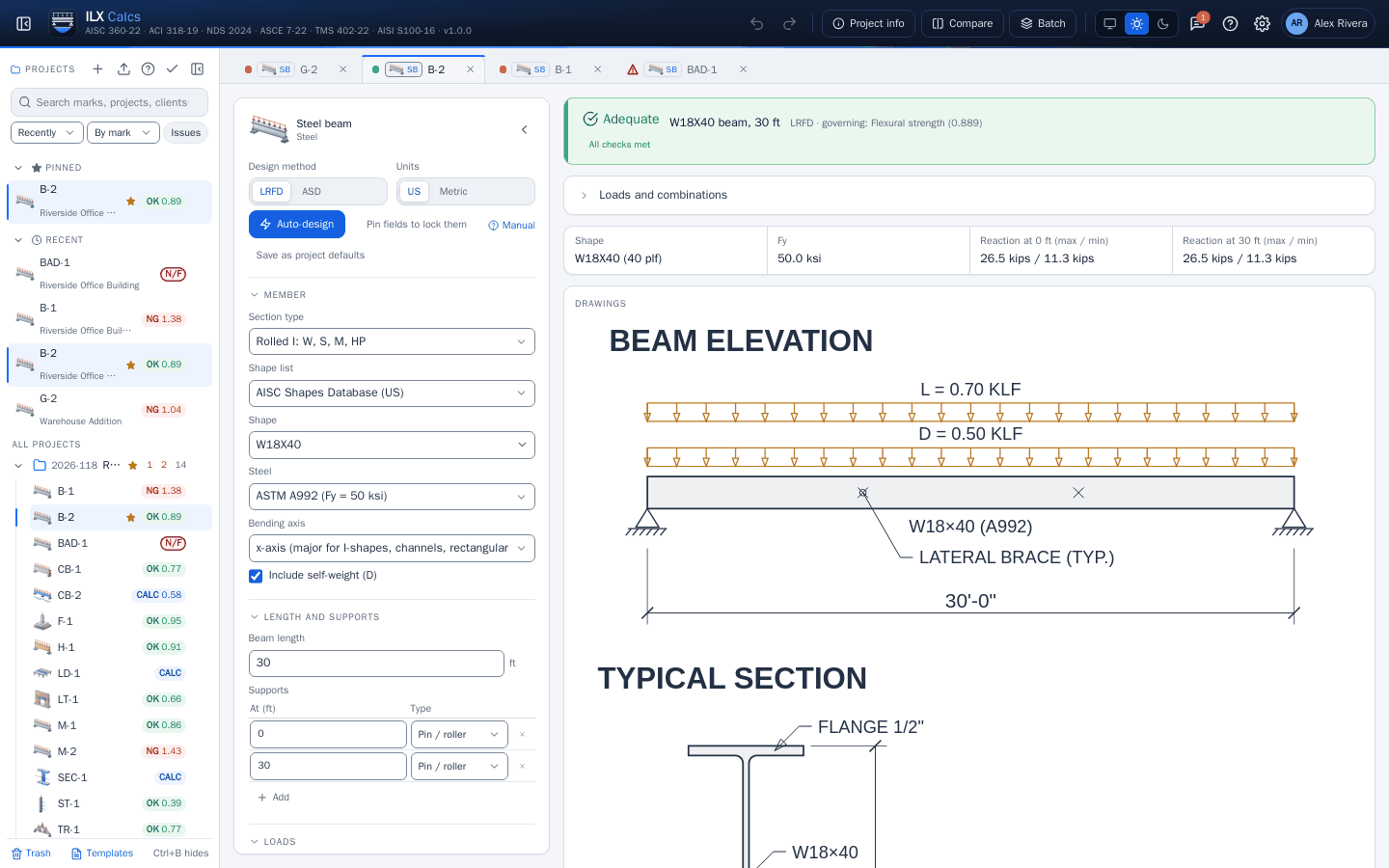
A floor beam, the one auto-design proposed in Training 4.
Inputs (Steel beam, LRFD):
| Input | Value |
|---|---|
| Shape, Steel | W18X40, ASTM A992 |
| Beam length, supports | 30 ft, pin / roller at both ends |
| Line loads | D = 0.5 kip/ft, L = 0.7 kip/ft |
| Self-weight | Included |
| Compression flange braced | At a spacing of 10 ft |
| Deflection limits | Span / 360 live, span / 240 total |
Results: W18X40 beam, 30 ft, Adequate, governing flexure at 0.889.
| Check | Clause | Required | Available | Ratio | Governs |
|---|---|---|---|---|---|
| Flexural strength | AISC 360-22 F2 | 198.9 kip-ft | 223.7 kip-ft | 0.889 | 1.2D + 1.6L |
| Shear strength | AISC 360-22 G2.1 | 26.5 kips | 169.2 kips | 0.157 | 1.2D + 1.6L |
| Live load deflection | IBC 2021 Table 1604.3 (limit entered) | 0.719 in | 1 in | 0.719 | L |
| Total load deflection | IBC 2021 Table 1604.3 (limit entered) | 1.273 in | 1.5 in | 0.849 | D + L |
Read it. The factored reaction is 26.5 kips, also the shear. Braces at the third points give the 10 ft unbraced length: try Continuous and the flexural strength rises while the deflections stay as they are.
What it does not do. The end connections, bearing, concentrated force checks and the strength and stiffness of the braces are not part of this calculation. See Steel beam, limitations.
Other steel types work the same way. Columns, base plates, composite beams, joists and the rest have their own chapters, listed by subject in the overview.