
Training 12: Worked calculation, loads
The types in the Loads group give the loads you enter in other calculations. They do not pass or fail: their status is Calculated.
A floor beam takeoff #
New calculation, Load takeoff. A floor beam, 30 ft span, 10 ft tributary width, with 65 psf dead and 50 psf live, live load reduction on (interior beam).
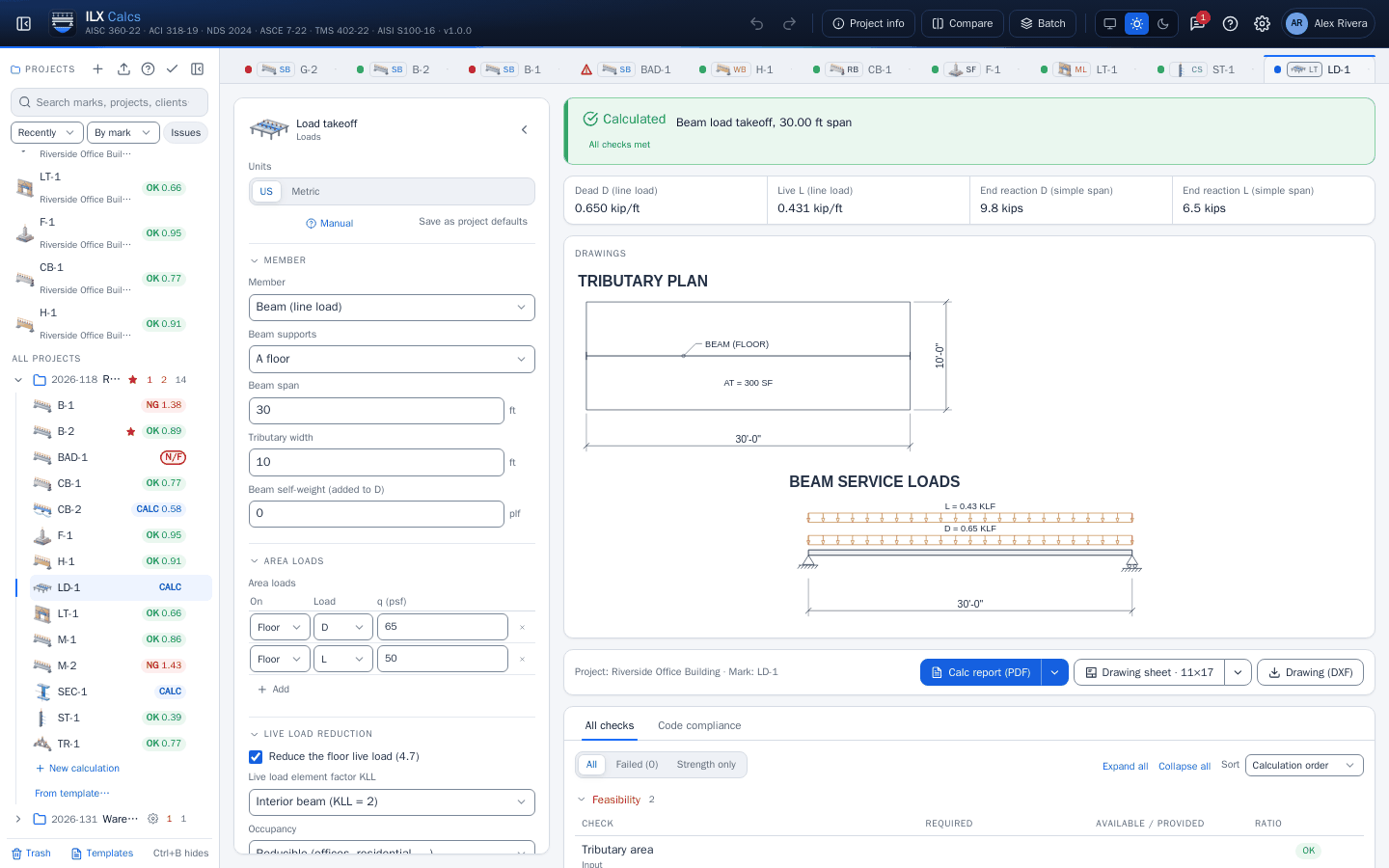
| Result | Value |
|---|---|
| Dead D (line load) | 0.650 kip/ft |
| Live L (line load) | 0.431 kip/ft |
| End reaction D (simple span) | 9.8 kips |
| End reaction L (simple span) | 6.5 kips |
The tributary area is 300 ft², so ASCE 7-22 Eq. 4.7-1 reduces 50 psf to 43.1 psf. The check row confirms that it stays above the 25.0 psf limit of 4.7.2.
Take these line loads to the beam: they are service values with a load type, exactly what the steel, wood and concrete beams ask for. Training 14 does that.
Combining effects #
New calculation, Load combinations. Three effects, by load type:
| Load type | P | V | M |
|---|---|---|---|
| D | 100 | 5 | 40 |
| L | 60 | 3 | 25 |
| W | 20 | 12 | 90 |
| Result, LRFD | Value | Combination |
|---|---|---|
| P, largest | 216.000 | 2a: 1.2D + 1.6L |
| P, smallest | 70.000 | 5a: 0.9D − W |
| M, largest | 163.000 | 4a: 1.2D + W + L |
| M, smallest | -54.000 | 5a: 0.9D − W |
The table lists every combination. Use it to check another program's output, or to size something this app does not design.
Other load types. Wind, snow, seismic, rain, flood and tornado have their own chapters, each stating what it computes and what it leaves to you. They are tools: site parameters and classifications remain your input.